It’s been one year since the 2019 Women’s World Cup, and to celebrate that anniversary I’m going to take a look at some of the finest teams in international history. I’ll start off by analysing the US women’s national team (USWNT) side of 1991, winners of the first Women’s World Cup.
BACKGROUND
The USA side of 1991 was special for several reasons. Obviously, winning the first Women’s World Cup was a big one, but so was their approach to the tournament. They essentially set the tone for future US women’s teams in terms of mentality, culture and – to an extent – tactics.
The 1991 team were coached by Anson Dorrance, who was appointed in 1986. Before becoming national team coach, Dorrance was building a dynasty at the University of North Carolina, taking the women’s soccer team – the North Carolina Tar Heels – to four NCAA (National Collegiate Athletic Association) championships. Without real organisation at international level, Dorrance used his North Carolina side as a testing ground of sorts, building a framework for the national team.
With a blank canvas to work on, Dorrance decided to set his team up in a way that he felt reflected American culture. His USWNT would play with aggression, physicality and belief, attacking and pressurising the opposition at every opportunity. Many of the top European sides were playing a possession-based style at the time, so the USA’s tactics shocked them at the 1991 World Cup.
THE 3-4-3
The USWNT of ‘91 set up in a system that was unique at that time – a 3-4-3 featuring three central defenders, two central midfielders, two ‘flank’ midfielders, and three forwards.
“We didn’t worship at the altar of the 4-4-2 and we didn’t play the ball around in the back for half an hour to show we could possess it,” Dorrance said when describing the team’s tactical approach. “We built our foundation on…the individual duel. We were going to win every head ball, we were going to win every tackle, and we were going to win every 1v1 contest.”
In front of goalkeeper Mary Harvey was a back three of Joy Fawcett, Carla Overbeck and Linda Hamilton. Mia Hamm and Kristine Lilly took up the wide roles, while Julie Foudy and Shannon Higgins operated in central midfield. Up top, the ‘Triple-Edged Sword’ featured April Heinrichs and Carin Jennings on either side of star player Michelle Akers. Below is a basic look at the shape of the team.
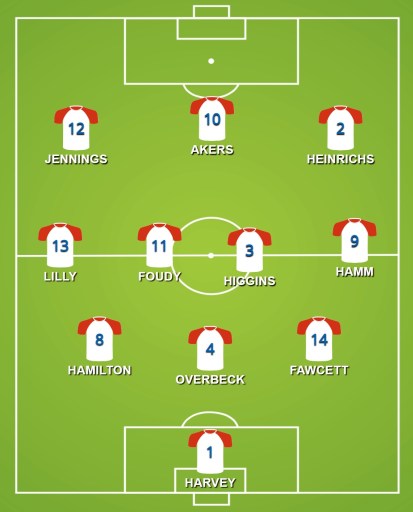
Interestingly, six of the preferred 11 (Overbeck, Hamilton, Higgins, Hamm, Lilly and Heinrichs) played for Dorrance at North Carolina, which no doubt helped in fostering tactical cohesion. Also, the squad was very young, with an average age of 24. Many of these players were in their physical peak or were approaching it. Several would go on to represent the USWNT well into the next decade.
ATTACKING THROUGH AKERS
The team’s attacking play was focused on playing forward quickly, with Akers the focal point. She was the target for long balls, using her physicality and aerial ability to either bring the ball down and link up, or flick on for the likes of Heinrichs and Jennings to run onto. She would also show for the ball, going short and receiving to feet, then laying off.
Akers was probably as complete a No.9 as you can imagine. She was stronger than most defenders, tall, good in the air, quick, fit, with excellent control and a powerful finish. In short, she was unplayable, and the USA could use her variety of qualities to attack directly in different ways.
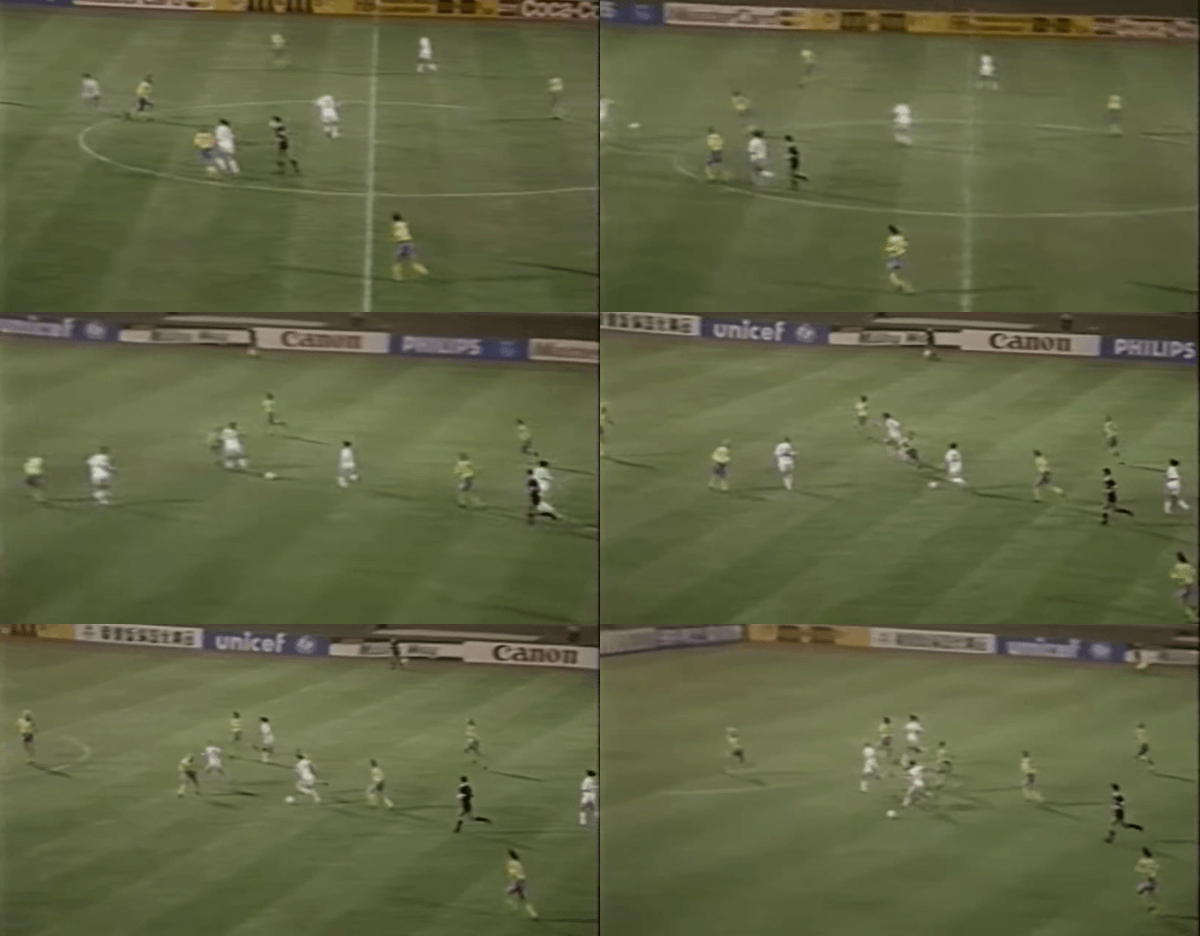
Below is an example of this attacking play, from the opening group stage win over Sweden. After a long ball falls in midfield, Higgins plays a through ball for Akers. Despite having her back to goal and a defender breathing down her neck, Akers plays a perfectly weighted one-touch lay-off for Heinrichs, who drifts in from the right. As soon as she has set the ball back to her teammate, Akers is off and running, looking to hit the penalty box to attack any ball that comes her way.
In the next group game, a 5-0 thrashing of Brazil, a slightly different example of the USA’s direct play is seen. Here, Overbeck plays a long ball in the air from the back. Akers drops off the frontline to receive, kills the ball instantly with her chest, and flicks it into the path of the on-running Higgins to drive forward into space. With three touches, two from their target striker, the USA were able to completely open up Brazil’s midfield.
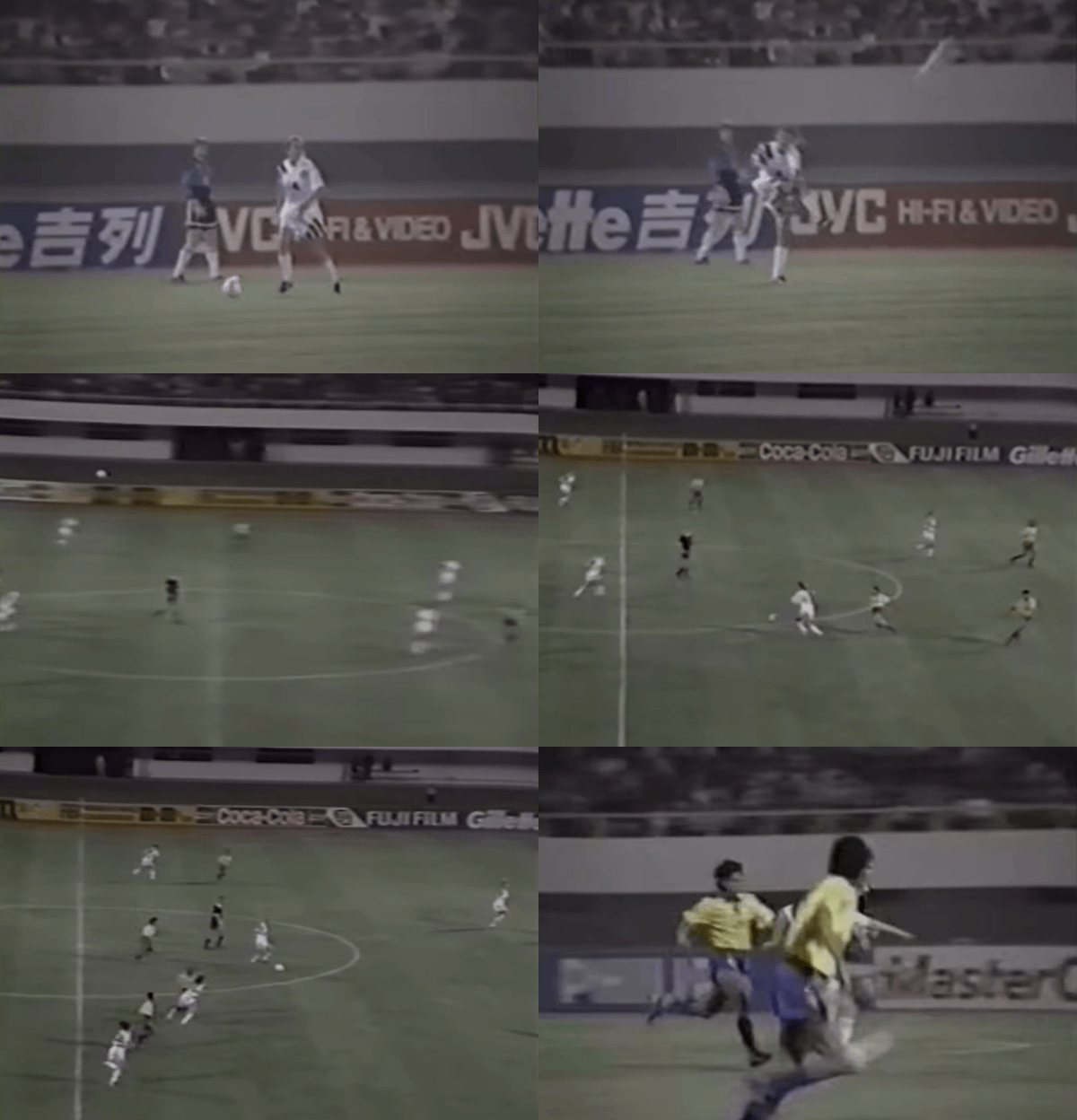
This direct attacking approach continued all the way to the World Cup final, where Norway were the USA’s opponents. Below, Fawcett plays a pinpoint ball over the top for Akers. With two defenders close by, Akers makes the ball stick with one deft touch. Without an abundance of options to lay off, she bides her time before turning and playing a through ball to Hamm, who has run beyond her.
There was very little side-to-side possession with this USA team. They looked to get forward quickly and directly, focusing on Akers’ strength, touch and link play. The pace and movement of Heinrichs and Jennings in behind, as well as the support runs from midfield by Hamm, Foudy, Higgins and Lilly, ensured Akers wasn’t isolated and always had options to connect with.
PRESSING EVERYWHERE
Perhaps the most important tactical aspect of Dorrance’s ‘91ers’ was their pressing. The front three would stay on the same line and work as a unit. They would allow the opposition centre-backs to possess the ball, but the nearest attacker would press forward on poor sideways passes or back-passes. And any ball into midfield came attached with real risk, as the USA’s middle four would press the receiver quickly and aggressively in the belief that, one-on-one, they could gain the upper hand.
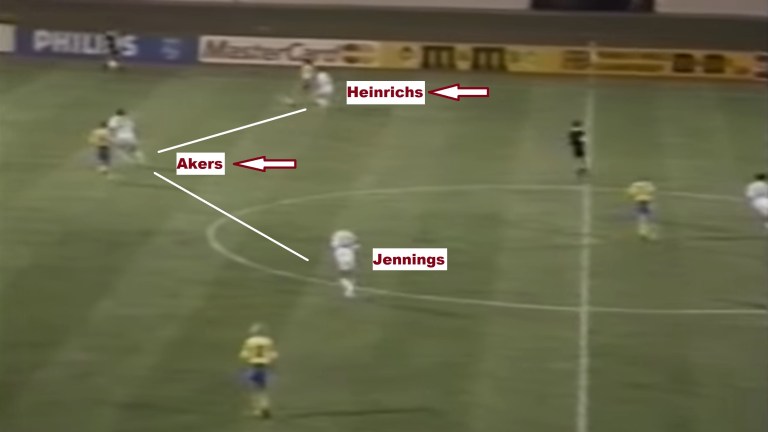
The image below comes from the opening game against Sweden, and shows how the front three was arranged. Rather than have the wide forwards drop back into midfield, they stayed aligned with Akers. Here, Sweden build out on the left flank, Heinrichs presses the ball, and Akers gets ready to press the back-pass.
In the semi-finals, the USA met Germany in a clash of styles. Germany were a heavily possession-oriented team, and they clearly were not ready for the intensity of pressing they were about to face.
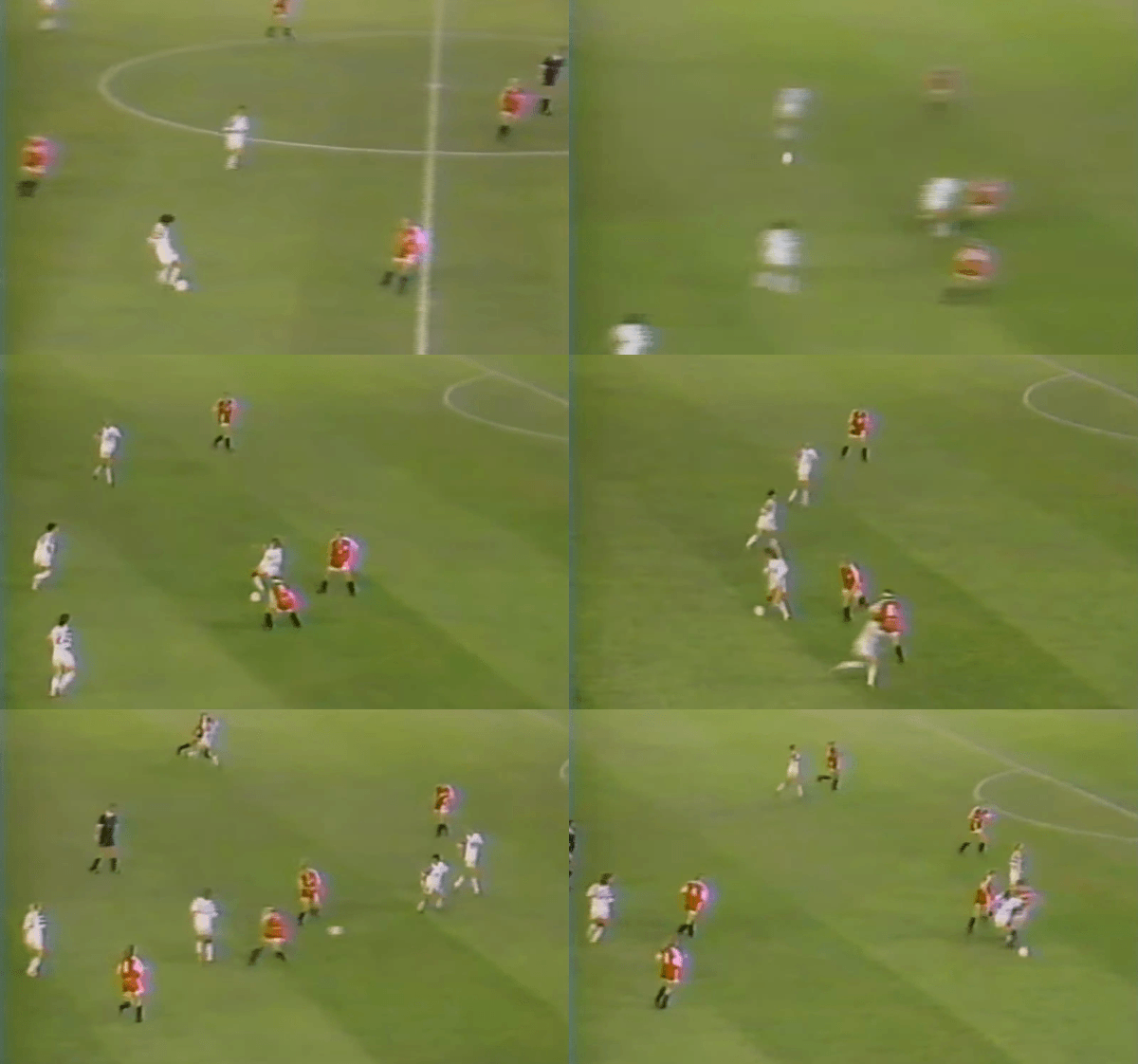
Here, a seemingly easy-going spell of possession quickly turns into a raiding counter-attack and a Jennings goal. A pass into midfield sees the receiver hassled relentlessly by Higgins and the ball goes back where it came from. The back-pass triggers Akers to step up, and the German centre-back panics under the pressure. A listless sideways pass invites Jennings to step up, intercept, and race away to score.
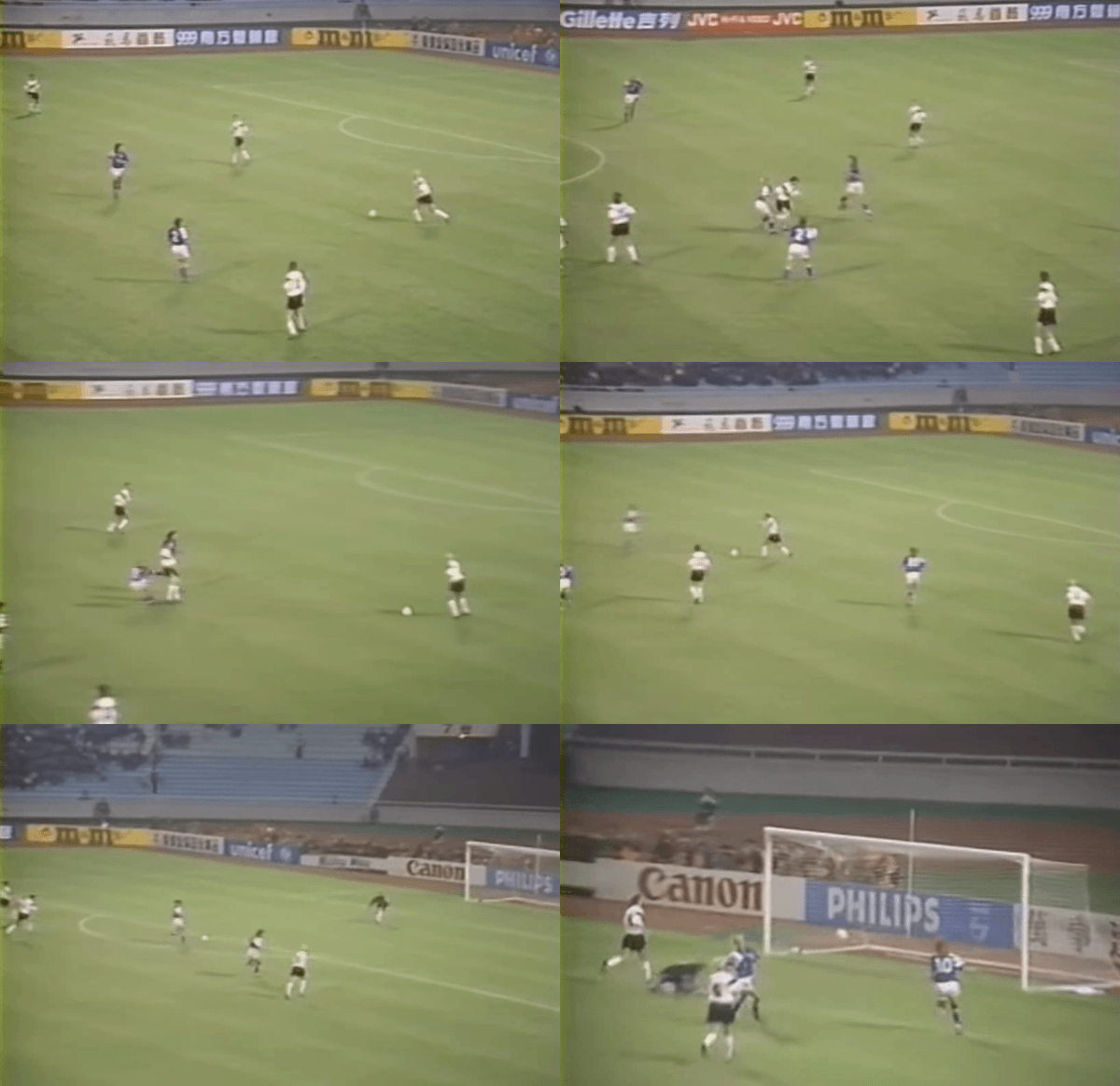
This is a good example of how the USA’s front three led in pressing. They moved as a unit depending on where the opponent passed the ball, ensuring they could always get good pressure on the ball-player and their nearest passing options.
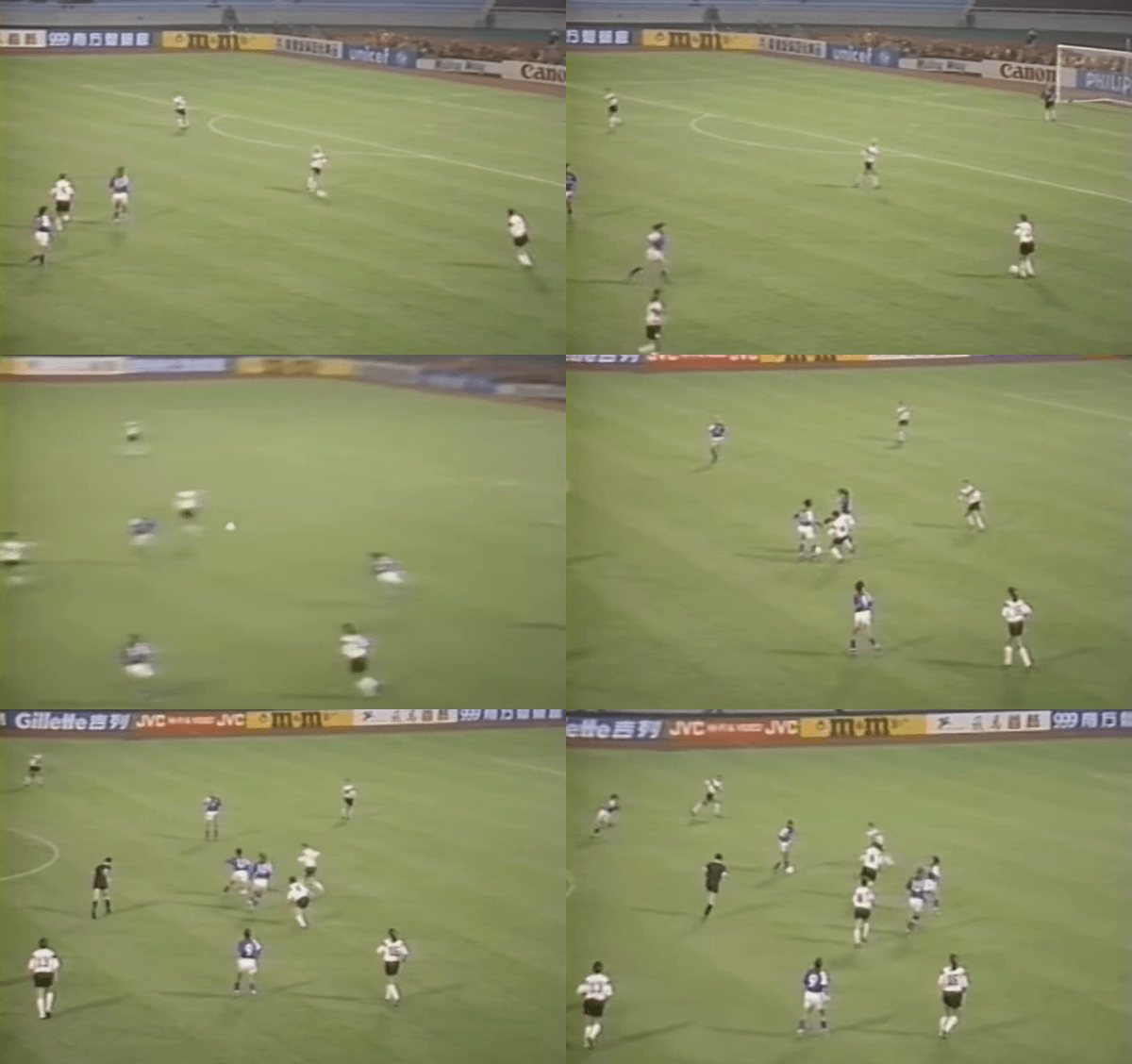
There was no let-up as Germany continued to build out short from the back, repeatedly trying and failing to play through the USA’s pressure. Below another sideways pass invites pressure from Heinrichs, who is able to partially deflect the ball into midfield. When the ball lands at the feet of a German midfielder, Foudy is already chasing her down and on hand to pick up the loose ball. Notice how Akers also dropped back to help out.
These were the days when goalkeepers were allowed to pick the ball up when it was passed back to them from the foot of a teammate, so there wasn’t always an opportunity to press. Norway effectively trolled the USA in the final by constantly passing the ball back to their ‘keeper at any moment the USA looked set to press forward, but Germany refused to adapt, ultimately losing 5-2.
Interestingly, when Germany eventually won the World Cup in 2003 – and then followed it up with a second straight title in 2007 – they did so with a game founded on organised pressing with a side filled with physical players like Birgit Prinz and Kerstin Garefrekes. They may not have learned from the USA during this game, but they certainly did afterwards.
CLINICAL COUNTER-ATTACKING
The ‘91 USWNT were excellent at pressing, but they were also clinical in their counter-attacking. Once they won the ball back, they immediately wanted to play it forward. They did this in different ways depending on the situation, but the emphasis was always on playing in their attackers as quickly as they possibly could.
In the below graphic, taken from the win over Sweden, we see more patient counter-attacking as the USA play out of pressure. Akers is once again the focal point, holding the ball and playing it back to a teammate with a better view. A pass is then played directly through to Heinrichs.
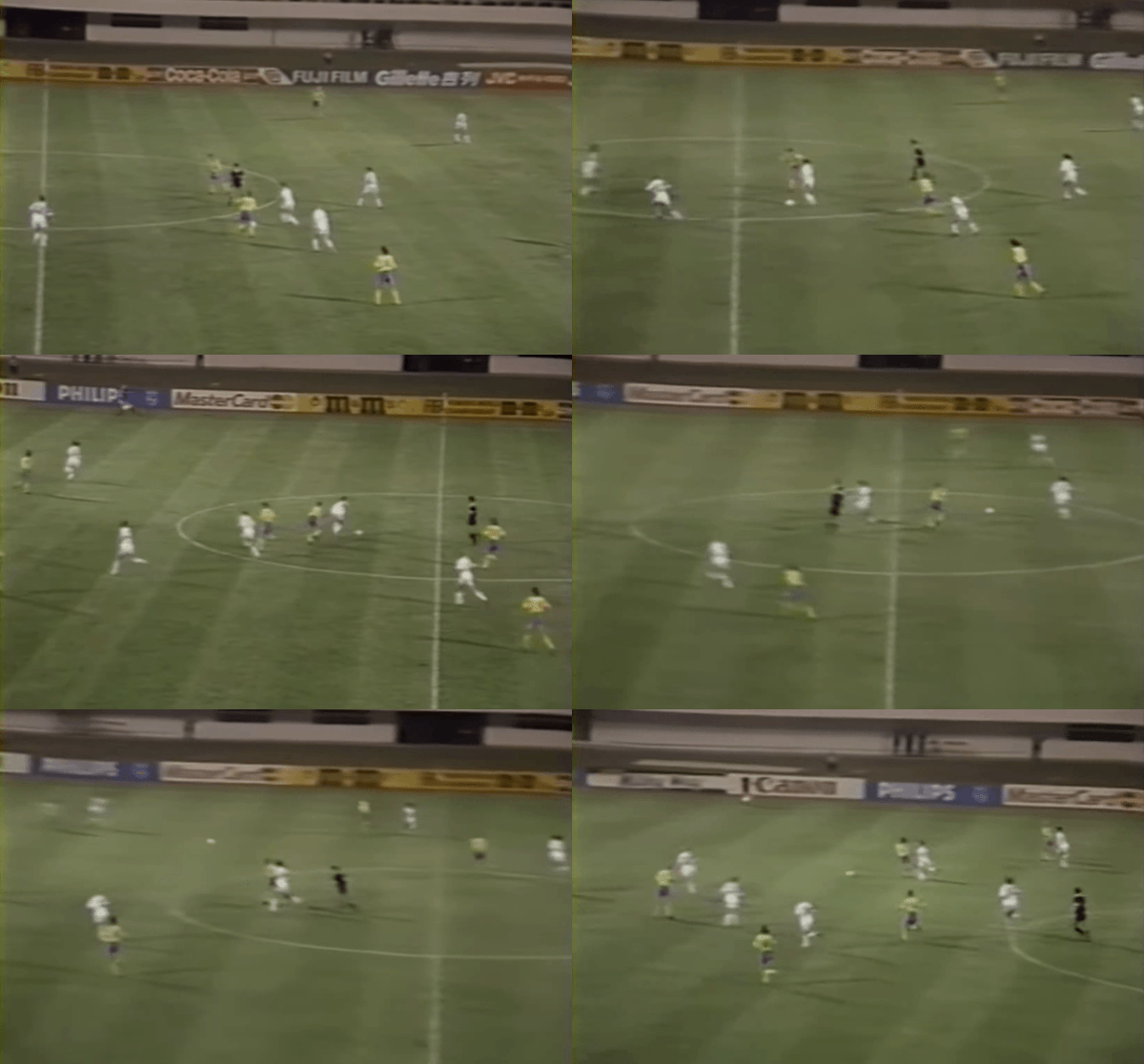
But this US side would be even more direct when they could. Here, against Brazil, we see Lilly winning the ball deep in her own half before looking up and spotting Heinrichs running into space. With one accurate long-range pass, she finds the forward, who is just too quick for her opponents.
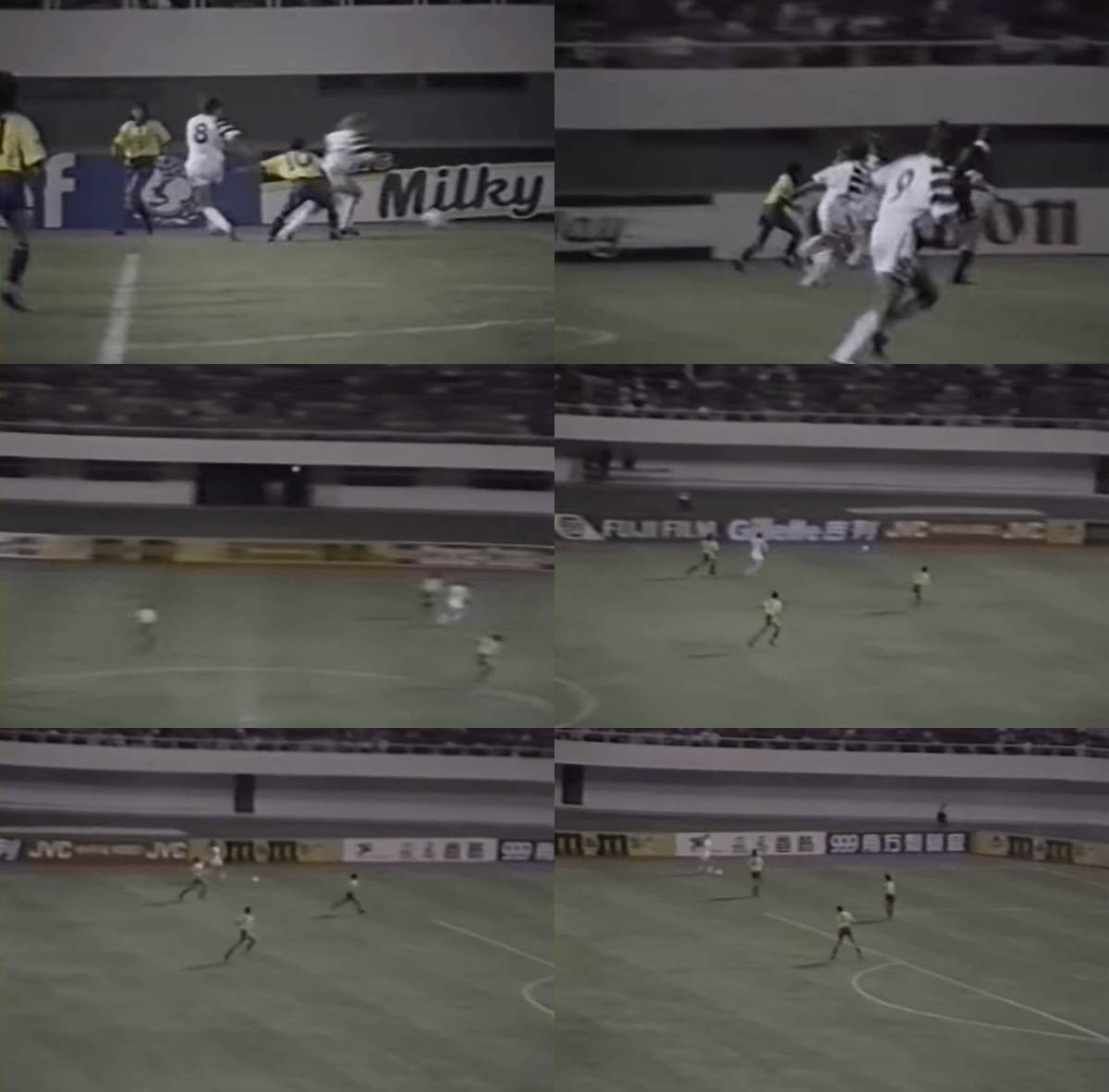
The front three were difficult to contain in transition. Akers could go 1v1 dribbling or in a physical contest and win, while Heinrichs had pace and constant movement. Jennings, nicknamed ‘Crazy Legs’, was probably one of the best dribblers the women’s game has ever seen, and was almost impossible to stop 1v1 with the ball at her feet.
With this forward line, the USA could counter patiently with Akers as the fulcrum for ‘up-back-through’ moves, or they could play the ball into space for one of the front three to run onto, or they could just give it to Jennings to beat multiple defenders. In moments of disorganisation, the Akers-Heinrichs-Jennings trident was ruthless.
FINAL THOUGHTS
The ‘91ers’ were ground-breaking. They were the first winners of a Women’s World Cup, and they won in a way that laid foundations for future US women’s teams to build upon. Their high-pressure, quick-transition style was ahead of its time, helped to promote the women’s game, and is something that could still be seen in last year’s World Cup winners.
Thank you for reading!
Blair (@thesecondball / blairn22@gmail.com)
 WoSo Analysis