One hour before this semi-final clash, the focus was on how each side would line up. Both made significant personnel changes, and as it transpired England also had a change of shape.
The USA replaced the injured Megan Rapinoe with Christen Press, while Sam Mewis was replaced in midfield by Lindsey Horan. These were essentially like-for-like changes that in and of themselves did little to alter the team’s usual 4-3-3 system.
England’s modifications were more tactical – they went with a 4-4-2 for the first time in the tournament, with Nikita Parris brought in to play just off of Ellen White up front. Fran Kirby was dropped, while Rachel Daly took Parris’ usual role out wide right. On the left wing, Beth Mead came in for Toni Duggan. Jill Scott took up a slightly deeper midfield role alongside Keira Walsh, while Carly Telford came in for Karen Bardsley in goal.

USA COMPACTNESS AND PRESSING
The USA defended in a 4-5-1 mid-block and allowed England’s centre-backs comfortable possession. Alex Morgan, rather than pressing Steph Houghton and Millie Bright, sat off as the US looked firstly to keep a compact shape. The wingers, Tobin Heath and Press, also contributed to this, tucking in on the midfield line and looking to intercept passes wide from England’s centre-backs out to the full-backs. If they couldn’t win the ball this way, they would track or close down the receiving full-back.
The USA’s shape and compactness allowed them to get quick pressure on the ball, sometimes from multiple angles, whenever England’s centre-backs tried to play passes to Walsh, Scott or when they attempted more ambitious passes through the lines. So while Houghton and Bright often had plenty of time on the ball, there were no easy forward passes for them to play. When the ball reached the middle third, the USA started to apply pressure man-to-man – Rose Lavelle and Horan on England’s central midfielders, and Heath and Press on England’s full-backs.

While from open play the USA sat off, they took English goal kicks or deep free kicks as an opportunity to press high. England like to build out from the back, and when they did so in these particular situations the USA would press in a similar manner to their high pressing versus France in the quarter-finals: the near-side winger stepped up to press the centre-back in possession while attempting to cut off the simple pass out to the full-back, while Morgan sat deeper near England’s deepest midfielder.
ENGLAND’S RIGHT-SIDED FOCUS
England persisted with building out and through the thirds, even when they came under pressure from the USA deep in their own defensive third. They were able to build out more effectively on the right side of the pitch, using triangles between Houghton, Scott and right-back Lucy Bronze, or between Bronze, Scott and right winger Daly. These triangles created passing options that made it easier for England to bypass the USA’s man-to-man pressure and retain possession, though play still broke down before the final third regularly due simply to the unsustainably high tempo of passing the USA forced England into.

Phil Neville’s choice of shape meant these right-sided connections weren’t seen on the left. Walsh naturally wanted to play closer to her normal central position, Mead wanted to stay high and closer to the left wing, while White wanted to get beyond the last line rather than drop off, meaning there often wasn’t an option for Bright to pass forward to in the left inside channel. This shortage of connections, added to the fact that Bright and Walsh are right-footed, made it difficult for England to play out down the left side as consistently as they did on the right.
The below graphic, courtesy of @WomensFootyStat (ran by @joedgallagher), underlines how right-side-focused England’s build-up play was. It also shows how difficult England found it to play through the centre and for their centre-backs to pick out White or Parris in these areas.

While her selection behind White was surprising, early on Parris found space well in the right inside and outside channels, and she was almost found on a few occasions through different movements.
At times, Scott would drop deep in the right inside channel, drawing Horan with her. White would position herself between the US centre-backs, pinning them in the process. Parris could then drop off from the front line without being followed, and found space due to Horan pushing up to press Scott. However, in order to find her, Houghton had to attempt chipped passes over the top of Horan which were difficult for Parris to control. Another series of movements saw Daly drop deep, drag US left-back Crystal Dunn with her, while Parris moved out into the space vacated by Dunn to receive.

Due to the USA’s compact defensive shape, England were generally unable to find their midfielders and forwards between the opposition’s midfield and defence lines as they did against almost every other opponent this tournament. Between this and the USA’s selective high pressing, England attacks mostly broke down before the final third, and occasionally led to turnovers deep in their own half.
USA KEEP IT SIMPLE
While England struggled to break the lines, the USA didn’t even attempt to. They did mix building from the back through short passing with long balls from back to front, but were not able to play through the centre due to their positional structure.
One or both of Horan and Lavelle often pulled wide when the USA were building possession, leaving Julie Ertz as the only midfielder in a central position. However, Ertz was fairly easily covered by England’s pressing. White and Parris would screen her before, when triggered by sideways passing between Abby Dahlkemper and Becky Sauerbrunn, one would step up to press the ball-playing US centre-back whilst also blocking the pass in to Ertz.
With their No.6 covered and Horan and Lavelle either moving wide or being easily closed down man-to-man from behind by Scott or Walsh, the USA centre-backs had no real passing options through the centre of midfield. They thus had to go wide to the full-backs. However, as England only fielded two central midfielders, their wingers couldn’t always push up and get close enough to press Kelley O’Hara and Dunn, who generally stayed deep to receive out from the centre-backs.

O’Hara and Dunn kept things simple. One option was to just play down the wing to Press or Heath. Another was to play out to Horan or Lavelle. With England’s full-backs pinned back by Press and Heath and their wingers pressing O’Hara and Dunn, Horan or Lavelle could get free near the touchline. An example of this is seen above, where Lavelle and Horan are circled near their respective wings. On the ball side, Lavelle is free as England’s left winger, Mead, is moving up to O’Hara, while left-back Stokes is pinned back by Heath. However, while this gives O’Hara a passing option, it’s high risk. If the pass is made, Lavelle receives the ball freely and can create a 2v1 with Heath on Stokes. However, if the pass is intercepted or the play breaks down somehow, the USA are incredibly open through the middle in transition.
England’s pressing was effective in closing off the centre, but the USA’s wide focus and directness when building out meant England couldn’t turn their pressing into turnovers and counter-attacks high up the pitch. Instead the USA played long and down the flanks, with the worst case scenario for them being they lost the ball out wide or in English territory, where they would recommence their own pressing.
WIDE OVERLOADS, OPENING UP THE PITCH, & CROSSES: USA FINAL THIRD PLAY
The movement wide of Lavelle and Horan continued when the USA were looking to break into the final third. Alongside the overlapping full-backs and the wingers, they created triangles and rotated positions in a bid to combine and break beyond England’s back line. By overloading near the touchline, they could also draw out the English full-backs and look to create space in the inside or outside channels – or, as Jill Ellis calls them, ‘Gates Two and Three’ – for their full-back, No.8 or winger to run into.
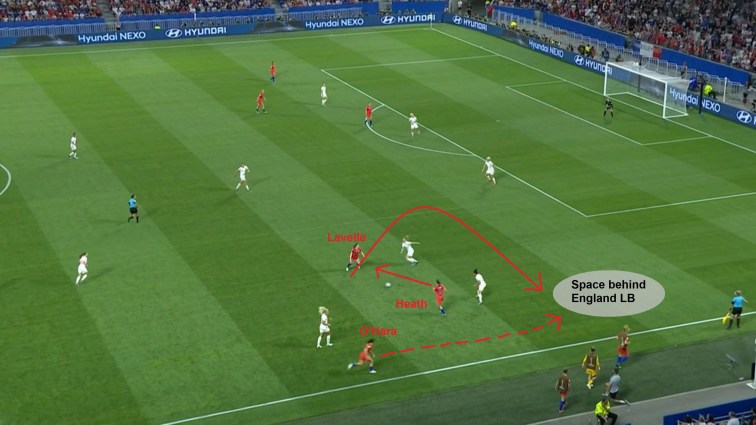
Another aspect of the USA’s play in and around the final third was the desire of their wingers to make the pitch as big as possible. Both Heath and Press looked to ‘get chalk on their boots’ by positioning themselves near the touchline. With England’s full-backs concentrating primarily on keeping a compact back line, the US wingers got time and space to receive and control, face goal, gather momentum and dribble inward at their opponents 1v1. These were threatening situations due to the quality of the players.
Heath is tricky and has great balance on the ball, uses feints to throw her marker off and is not averse to using her arms with subtle nudges to create distance and prevent tackles. She is also two-footed, so it’s difficult to predict whether she will go around the outside and cross with her right or come in onto her left. Fortunately for England, Demi Stokes did a good job of not diving in and showing Heath wide. As for Press, she wants to come in onto her favoured right foot, so is more predictable. However, the speed with which she can shift makes her tough to stop, and caused Bronze some problems.

Once again the USA’s primary offensive feature was the speed and intensity with which they attacked. While the wide spaces weren’t as open for their wingers here as they were against France, this didn’t stop them from looking to move the ball quickly to Heath and Press. And, once in the final third, they didn’t just stretch the pitch as much as possible and overload the wide areas – they also crossed into the box frequently.
Crossing led to two goals, but these goals were more about poor English back line organisation than quality delivery. More intriguing was the fact the USA always had good presence in and around the box, with two of their front three attacking the area, while their midfield three and near-side full-back all pushed up. All of this meant the US often had three or four players attacking the initial cross in, while two or three lingered on the edge of the box looking to pick up the second ball and shoot.
PROS AND CONS OF USA’S 5-4-1 SWITCH
With 20 minutes of normal time remaining and a 2-1 lead to defend, the USA changed shape and went to a 5-4-1 defensively. Ertz dropped between the centre-backs and the defensive line also dropped back by about 10 yards.
This change came after White had almost equalised for England with an exceptional run between Dahlkemper and Sauerbrunn before receiving a through ball from Scott and slotting home. The goal was disallowed for a marginal offside, but Ellis had seen enough. With the back line deeper, there would be less space for White to run in behind. And, with Ertz acting as a third centre-back, there would be less space in the channels between centre-backs for White to target with her intelligent movement.

While this switch made it more difficult for England to get in behind, it also reduced the coverage the USA had in central midfield to prevent passes through from England’s centre-backs. As a consequence, England were able to penetrate the US midfield line more easily and regularly. White and Kirby, who was brought on to play the No.10 role, could be found with passes to feet and then lay off to one another before attacking the USA’s back line. This led to England getting into some dangerous positions, but they were unable to create a real chance to equalise.
CONCLUSION
Once again, the USA had less possession than their opponent. Once again, it didn’t matter. The idea they play in intense bursts is incorrect – they just keep out-thinking their opponent, scoring first, and earning the right to manage the game and defend their lead.
 WoSo Analysis