Rather than do individual posts, I thought I’d analyse every single one of the World Cup quarter-finals in one fell swoop. I’ve broken this article down by game, and then by tactical aspects I’d like to explore. With graphics. Enjoy!
NORWAY 0-3 ENGLAND
Norway have varied between two line-ups this tournament, with the only major consideration being whether to line up in a 4-2-3-1 with Saevik alongside Hansen and Reiten in attacking midfield behind a lone striker, or to go for a 4-2-2-2 with Utland taking Saevik’s place and playing up front with Herlovsen. Here, they went for the former option, just as they did against France and Australia.
After Norway boss Martin Sjogren suggested that England “don’t like to run” before the match, Phil Neville changed his side’s shape slightly, with Kirby playing closer to White in a defensive 4-4-1-1. The midfield four was Parris, Scott, Walsh and Duggan, while Bronze, Houghton, Bright and Stokes made up the back four in front of Bardsley. Offensively, the shape was the usual 4-3-3, with Scott moving up to play in a more advanced role on the same line as Kirby.
ENGLAND ADAPT TO NORWAY’S UNIQUE BUILD-UP
Norway’s attacking structure is unique in this tournament and caused teams problems. Their central midfielders, Risa and Engen, play in front of the centre-backs, Mjelde and Thorisdottir, forming a box shape that allows the full-backs, Wold and Minde, to take up more advanced positions down the flanks. This in turn means Saevik and Reiten can come inside and operate with Hansen between opposition midfield and defence lines.
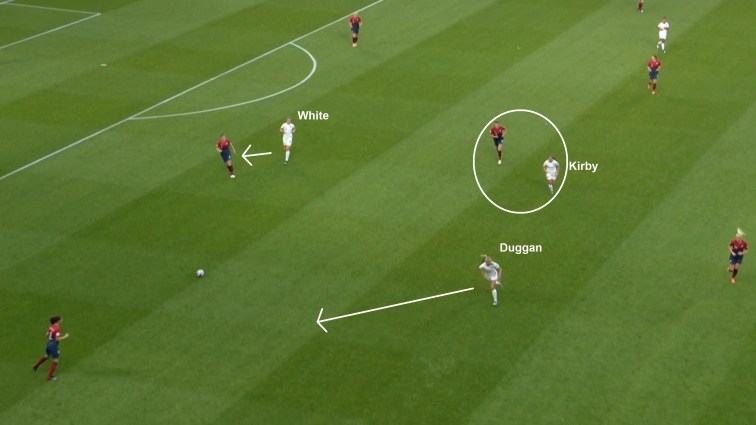
Neville’s change of shape allowed England to get good pressure on the ball, however. White would split the Norway centre-backs before pressing the one with the ball, while Kirby supported her from behind. When White split the centre-backs, Kirby would then cover the near-side Norwegian midfielder, meaning she could press quickly if her opponent received the ball. This high pressing forced Norway’s build-up down one side, and prevented short passing combinations between the centre-back and midfield ‘box’ to create the free player to then drive forward or pick a pass.
The next issue England had to solve defensively was how to stop Hansen, Reiten and Saevik from receiving between the lines. This was done through having an extra central midfielder alongside Walsh in Scott, ensuring there were always two players on hand to cover the spaces Norway’s attacking midfield trio wanted to take up.
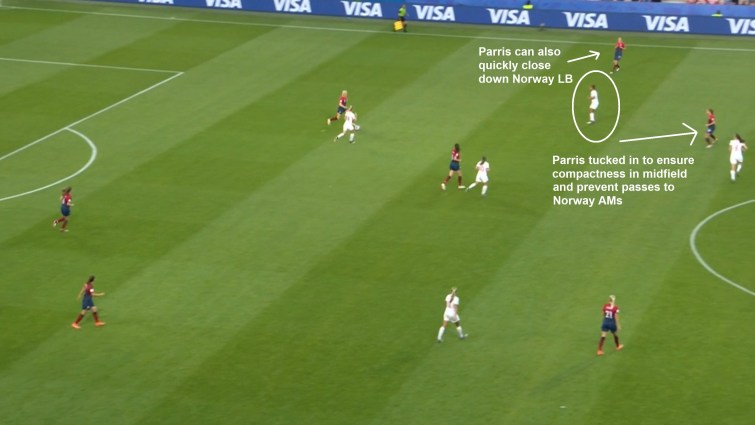
More important was the defensive positioning of England’s wingers, Parris and Duggan, who both tucked inside to close the space in the channel between themselves and their central midfield teammates. This ensured a compact midfield line, which made it difficult for Mjelde and Thorisdottir to thread balls through to the dangerous Hansen and Reiten. If they forced Norwegian build-up wide to their full-backs, Parris and Duggan would then close down the receiving full-back whilst also making sure to screen the pass inside.
ENGLAND’S RIGHT-SIDED FOCUS
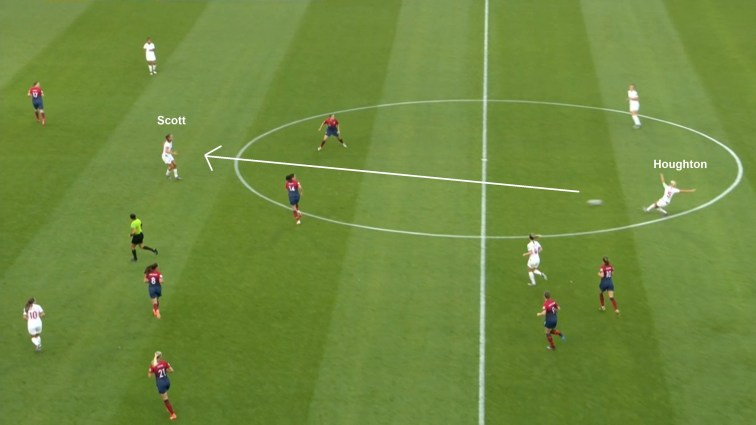
Norway defended in a more passive 4-4-2 mid-block, as they had done throughout the tournament, and looked to force England possession wide or intercept attempted through balls. While Australia and France didn’t penetrate their block, England were more able and willing to do so. Scott and Kirby took up positions between the Norwegian midfield and defensive lines and in the channels between Norwegian midfielders; England then passed from side to side around their back four looking to stretch Norway’s midfield line and find gaps to play through and find their No.8s.
Houghton showed her quality on the ball on a number of occasions to pick through balls to Scott and break two lines of Norway defence in the process. From there, England could attack Norway’s last line of defence with Scott and Kirby running forward, White attacking centrally and Parris and Duggan looking to get around the outside.
The right-hand side was particularly productive. Parris, with her pace and dribbling ability was a constant threat up against the much slower Minde, and she was supported by the overlapping and underlapping runs of Bronze from right-back. The duo consistently got beyond and hit the by-line before cutting the ball back for the likes of White and Scott to shoot. Indeed, two of England’s three goals came from Parris and Bronze getting around the outside of Norway’s defence and pulling the ball back in the penalty box for clean shots at goal from close range.
NOT EVERYTHING IS AL(B)RIGHT
While Norway were generally passive in their 4-4-2 defensive block, they did frequently press England’s centre-backs on one specific trigger – when Bright received the ball. One of their defensive front two (usually Hansen) would move to press Bright from the inside to out, taking away the pass across to Houghton and forcing Bright onto her weaker left foot.
Bright is an adept passer on her right foot, but on her left she tends to keep it simple and pass out to the left-back – in this case Stokes. The near-side Norway wide player would then close down Stokes, while Walsh, England’s No.6, would be covered by Herlovsen.
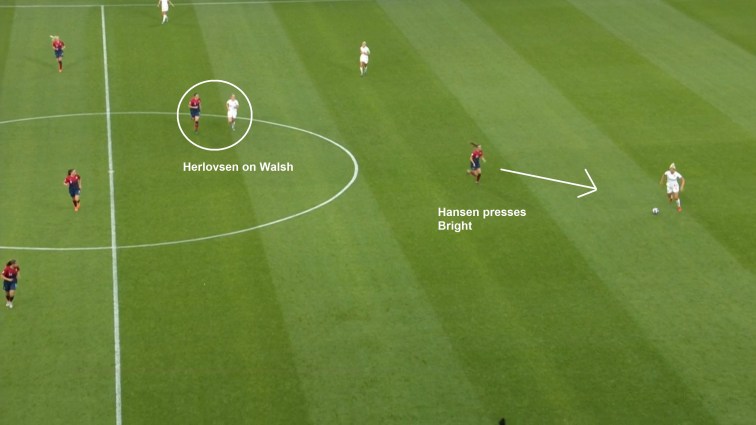
Once Bright was forced onto her left, England’s build-up suffered drastically. It became more predictable, inviting pressing. Another issue was that Walsh is naturally right-footed, so like Bright is not so comfortable receiving on her left side in build-up. On her right, she can play first-time forward passes through pressure, but on her left it’s far more awkward.
At best all of this allowed Norway to force England down their offensively weaker flank, away from the right and the combination of Bronze and Parris. At worst it led to turnovers of possession in England’s half. USA, who meet England in the last four, may want to take note.
NORWAY CREATE BUT DON’T FINISH
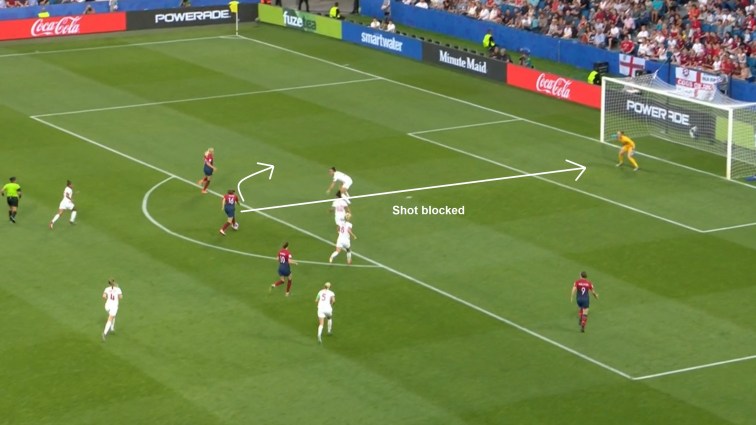
Even though England pressed very well and limited Norway’s attacking progression, it still occasionally didn’t work or led to broken play that Norway capitalised on to transition into attack. Herlovsen made great runs across the forward line looking for through balls, but was often ignored as Norway made bad decisions in the final third. They seemed focused on getting the ball to Hansen, meaning simpler passes to Herlovsen or Saevik were missed in favour of less penetrative balls or shots from bad angles. Below, Reiten opts to try and shoot through two England defenders and is blocked, when the through pass to Saevik was on.
After England had gone 3-0 up, Norway brought on Utland for Saevik and went to their other attacking shape of 4-2-2-2. This, along with some English complacency that saw bad passes and touches from Bright and Bardsley, led to scoring opportunities for Norway.
Utland’s arrival added another presence for England’s defenders to deal with, and they didn’t deal well. At times the English back four was made up of players on completely different lines as they struggled to cope with one striker dropping back while another ran beyond. Bright was culpable for following her opponent out of her positional slot and opening the channel between her and Houghton for Norway to penetrate through. But these chances didn’t lead to Norwegian goals, and England continued on into the semi-finals.
FRANCE 1-2 USA
France lined up for this highly anticipated clash in the same system they have used since the start of the tournament. Their defence was unchanged, with Bouhaddi protected by a four-player line of Torrent, Mbock, Renard and Majri. Henry and Bussaglia formed the double pivot in front of them, with Thiney supporting lone striker Gauvin. Diani and Le Sommer were respectively the right and left wingers.
As for the USA, they set up in the same basic 4-3-3 shape they have used, albeit with one slight alteration – defensively, striker Morgan dropped deeper centrally than normal. Heath and Rapinoe were, as always the wingers on either side of her, while the central midfield trident was made up of Lavelle, Ertz and Mewis. The back four contained O’Hara, Dahlkemper, Sauerbrunn and Dunn, while Naeher continued in goal.
USA’S NEW PRESSING STRATEGY
France have generally overwhelmed their opposition through the sheer quality of their individual players and the sheer quantity of balls played into opposition penalty boxes, but their build-up play has become quite predictable. The USA became the first team to truly focus on exploiting this, adapting their pressing in order to do so.
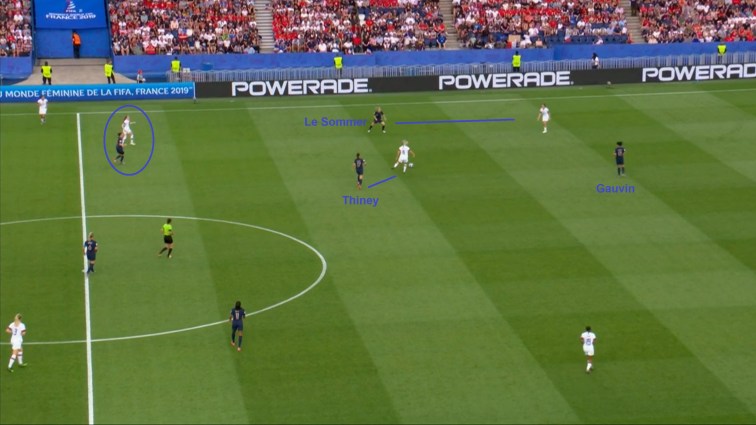
Normally, their front three is a narrow flat line that discourages or blocks forward passes into midfield from opposition centre-backs. However, on this occasion Morgan dropped back to cover the French double pivot, marking whoever out of Bussaglia and Henry was nearest to the ball. Meanwhile, Heath and Rapinoe took it in turns pressing the French centre-backs from outside to in whenever they received the ball. This took away the centre-backs’ time on the ball and cut off the simple passes out from centre-back to near side full-back, often forcing the French down the middle. But with their central midfielders closely marked or threatened by the deeper positioning of Morgan (circled), it wasn’t easy for France to build out this way, either.
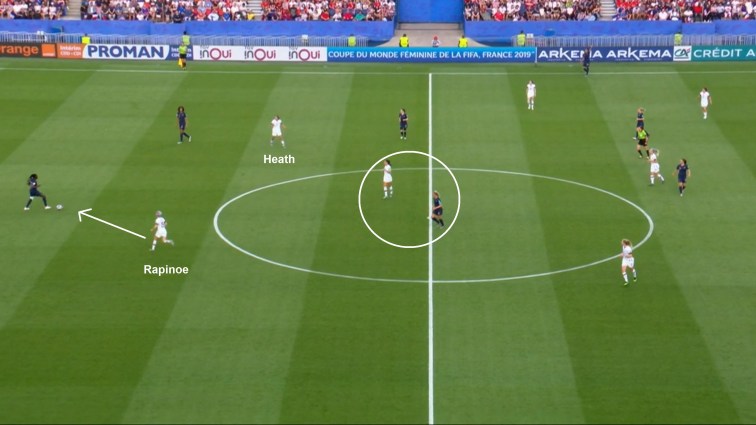
Even if they could find Henry or Bussaglia, France simply aren’t set up to break the lines. Le Sommer came inside from her left wing role and took a more central position, while Thiney also took up some good positions in the channels on USA’s midfield line. But they were rarely found as France build-up is geared towards setting up with short passes between the centre-backs and double pivot, allowing the full-backs to push up and spraying diagonal balls out wide for overloads and crosses or dribbles and cut-backs from their wingers. By making it harder for France to set up these wide attacks, the USA stopped their hosts from getting into any rhythm with their possession.
USA COUNTER, THEN ADAPT
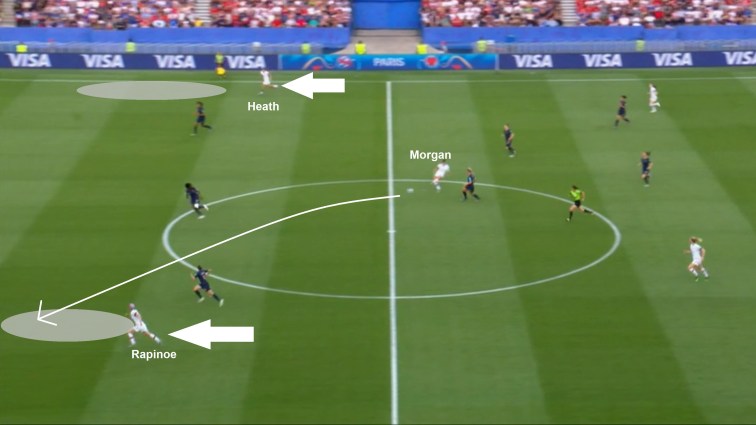
The other benefit of USA adopting this new defensive setup was that it allowed Heath and Rapinoe to play higher on the counter-attack. The US are a quick counter-attacking side that always look immediately for the forward runs of their high front three whenever they regain possession, and on this occasion they were perfectly shaped to exploit the spaces left by France’s attacking full-backs.
Both Torrent and Majri push on offensively for France, and this leaves gaps on either side of their central defenders. Here, Heath and Rapinoe were positioned well to run into these gaps. Instantly upon winning possession, the USA played balls over the top or through into these areas for Heath or Rapinoe to run onto and attack. In the example below, Morgan drops deep to receive in transition (Renard and Mbock can’t follow her as they are essentially the only defenders left) and immediately plays a through ball for Rapinoe. People have criticised Renard at this tournament, but her and Mbock have been left high and dry in transition by the French system time after time, and the USA took advantage of this consistently.
Midway through the first half, after going 1-0 up, the USA coaching staff held up a board with a sign that read ’41’. Following this, they changed defensive shape, going to a less aggressive 4-1-4-1 with Rapinoe and Heath dropping back onto roughly the same line as Mewis and Lavelle. With a lead to defend, the US focused less on pressuring France’s centre-backs and more on tracking the full-backs’ forward runs, with their wingers positioned deeper to accomplish this. While this gave Renard, Mbock, Henry and Bussaglia slightly more time on the ball when building out, the French continued to struggle to create scoring chances.
FRANCE LACK PLAN B
France started with a high press that saw Gauvin pressing the ball-playing US centre-back while Thiney covered Ertz and the near-side winger and central midfielder marked or closed down their opposite players.
However, after conceding an early goal the game state completely changed – the USA were more interested in defending their lead and counter-attacking, and the onus was now on France to break them down. Corinne Diacre’s side didn’t react well. Their Plan A didn’t work due to the USA’s pressing and also because the USA have defenders with pace that aren’t overawed by having to defend 1v1 against tricky wide players; this was particularly evident on the left where Dunn did a good job of bottling up Diani whenever France’s right winger got the ball.
In addition, France attacks were continually scuppered by misplaced passes, poor quality final balls and a lack of options in the US penalty box – often Gauvin was the only target for crosses. France passing appeared nervy and indecisive, which is what happens when you concede a soft goal five minutes in to the biggest game of the tournament in front of an expectant home crowd.
Unable to get their high press going due to the USA’s disinterest in having concerted possession, and unable to build as they would normally do due to the USA’s pressing, defending and their own individual errors, France had to re-think their approach. But they didn’t. They persisted with the same shape and style and made just two substitutions, the first of which came in the 76th minute. By that point they were 0-2 down.
USA SEE OUT GAME IN 5-4-1
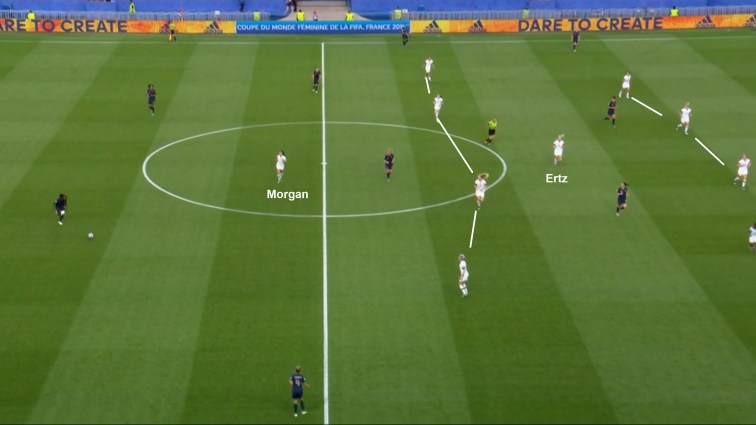
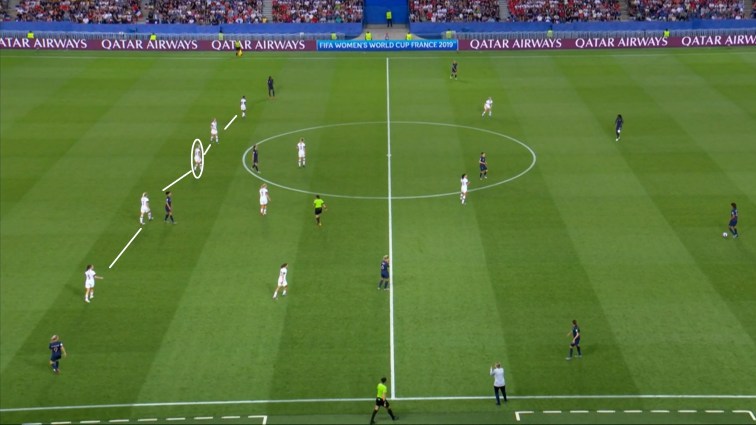
Jill Ellis came in for criticism after the USA’s lacklustre display against Spain, but here she adapted her team’s tactics throughout the match to suit the situation. At 2-0, she went even more conservative and had Ertz (circled) drop between the two centre-backs to form a 5-4-1 shape without the ball. This increased the numbers the USA could get around the ball whenever France advanced into the final third and made it even harder for the hosts to find defensive gaps to exploit. It may not have been spectacular, but it worked, and Ellis deserves credit for her plan(s).
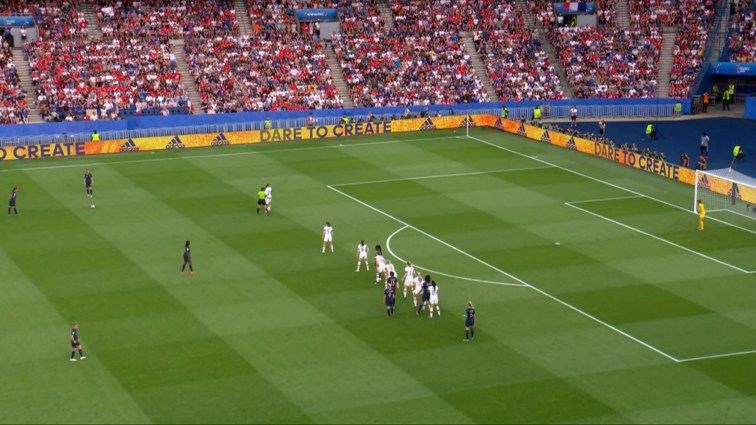
Another positive aspect of the USA’s defensive play was their defending French free kicks. France have real aerial presence in their side but the USA kept a high line in these situations to prevent simple lofted crosses into their own box hitting tall French targets such as Renard, Mbock or Henry. One mistake which led to France’s only goal aside, the USA essentially took away one of France’s primary attacking weapons by taking their aerial targets far away from the danger zone.
Ultimately, the USA had 39% of possession to France’s 61%, and had just 10 shots to France’s 20. However, eight of their shots were on target, compared to France’s five. Ellis’ counter-attacking strategy worked a treat.
NETHERLANDS 2-0 ITALY
Italy generally stuck by a 4-4-2, with some flirtation with a 4-5-1, on their way to the last eight, but changed to a 4-diamond-2 for this game. Their defence was familiar, with goalkeeper Giuliani protected by centre-backs Gama and Linari, though Guagni and Bartoli swapped flanks, with the former moving to left-back and the latter to right-back. The midfield three was Bergamaschi, Giugliano and Cernoia, while Galli played behind a front two of Bonansea and Giacinti.
The Netherlands continued with the same shape and personnel that led them to victory over Japan in the last 16: a 4-3-3 featuring Van Veenendal between the posts, a back four of Van Lunteren, Van der Gragt, Bloodworth and Van Dongen, a midfield three of Groenen, Spitse and Van de Donk, and a front three of Van de Sanden, Miedema and Martens.
ITALY’S DEFENSIVE SWITCH AND DUTCH FULL-BACK INFLUENCE
The Netherlands have had trouble progressing possession from the back against compact, zonal 4-4-2 defences, so it was a surprise to see Italy veer away from this shape here. Milena Bertolini lined her side up in a 4-3-1-2 that saw Galli starting as the ‘1’ behind the strikers. Defensively, this meant their strikers could close down the Dutch centre-backs while Galli covered their No.6, Spitse. However, Giacinti and Bonansea rarely put pressure on the centre-backs, which gave Van der Gragt and Bloodworth time to play passes out to the full-backs.
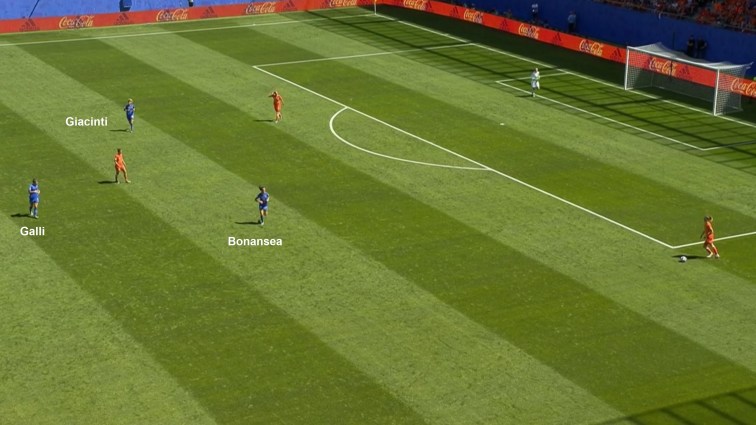
Van Lunteren and Van Dongen were often free to receive and could carry the ball forward unchallenged, as Italy’s strikers didn’t move out to close them down and their midfield three had a lot of ground to cover laterally, meaning they couldn’t get out to press quickly without tiring or potentially allowing gaps to open in their midfield line.
Free to drive forward, Van Lunteren and Van Dongen became key to the Dutch attacking play. Their decisions – where to dribble, how quickly to advance, who to pass to, when to pass to them – often determined the effectiveness of their team’s build-up. They were helped by the movement and individual quality in front of them provided by Groenen, Van de Donk, Martens and Van de Sanden.
NETHERLANDS PROGRESS IN WIDER AREAS
Predictably, most of the Dutch ball progression came in the wider areas. They progressed through or around the Italian defensive block in a number of different ways. One way was for the ball-near No.8 – Groenen or Van de Donk – to move on the blind side of the near-side Italian midfielder. As the Dutch full-back drove forward and committed the Italian midfielder, Groenen or Van de Donk would move behind them to receive a penetrative pass.
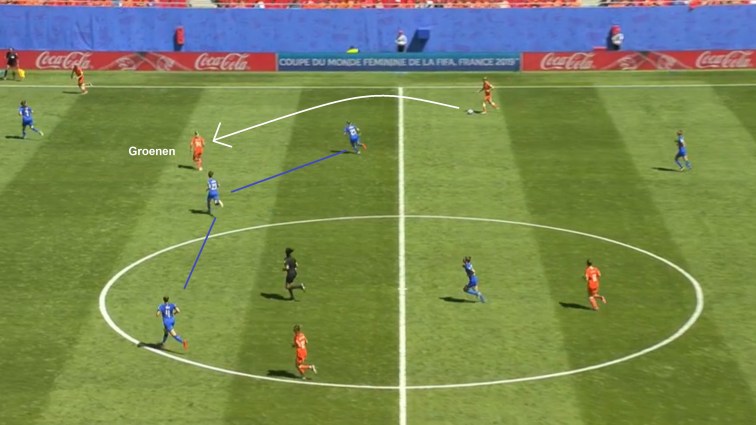
Another way was for the Dutch full-back, No.8 and winger on the ball side to form a triangle, creating multiple options for combination play to outmaneuver their Italian counterparts with quick, one-touch passes. One-twos were one option for combinations between full-back and winger; another was give-and-goes – i.e. full-back to winger, full-back runs beyond and receives ball in behind from winger.
It’s worth noting that the right-hand side was the more effective side for Dutch attacking, as Van Lunteren was more aggressive with her dribbling, runs and and passing than the safer Van Dongen on the left, who preferred to hold her position more and play simpler passes down the line to Martens.
And it’s also worth noting that the Dutch reliance on their wide players continued: at times as they looked to advance possession or counter-attack in transition, they would simply give the ball to Van de Sanden or Martens and hope they could produce something 1v1 with a shimmy, a turn of pace or a telling pass.

VAN DE DONK APPRECIATION
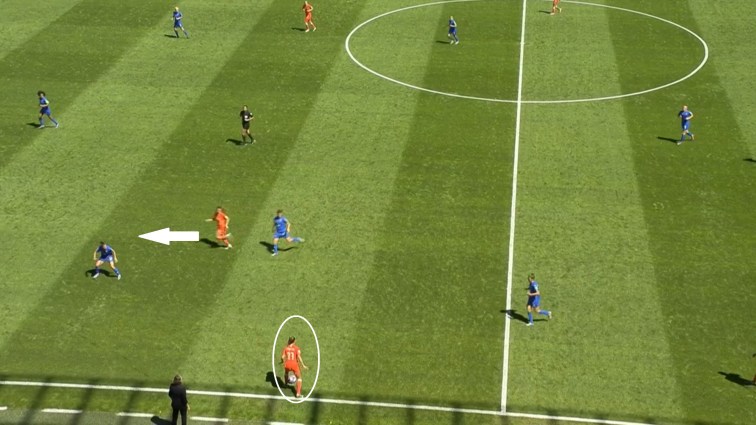
The Netherlands have quality players throughout their side, and their front three gets a lot of attention. However, Van de Donk has been the thread that knits attacks together for them in this tournament. Her understanding of space was on show against the Italians, as she moved intelligently laterally and vertically to open passing lanes or create space for her teammates.
Here, she makes a forward run that pins back Italy right-back Bartoli, stopping the Italian from pressuring and allowing Martens (circled) to receive in more time and space on the wide left.
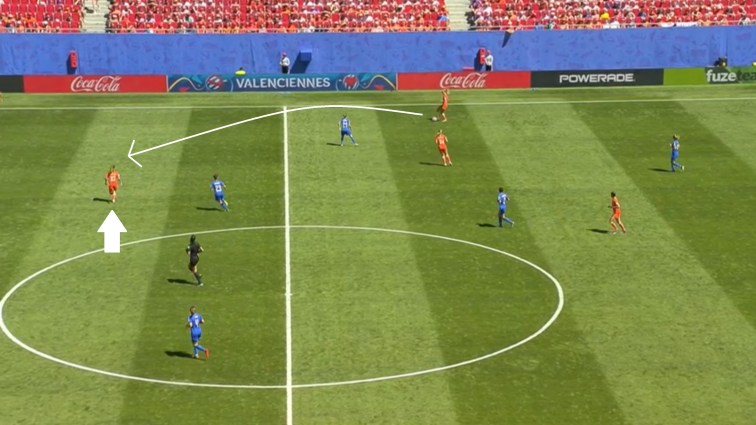
And here, she recognises the nearest two Italian midfielders are drawn to Van Lunteren and Groenen, so she makes a run into the opening space behind the Italian midfield to enable a line-breaking pass from Van Lunteren.
ITALY RUN OUT OF WIDTH AND IDEAS
Italy’s failure to effectively press the Dutch into turnovers meant they only obtained 37% of possession. Worse still was the fact they were almost completely lacking in ideas whenever they did have the ball. The change of formation seemed to impact on their ability to build out and through the thirds as they did throughout their first four games, meaning they rarely created serious scoring chances.
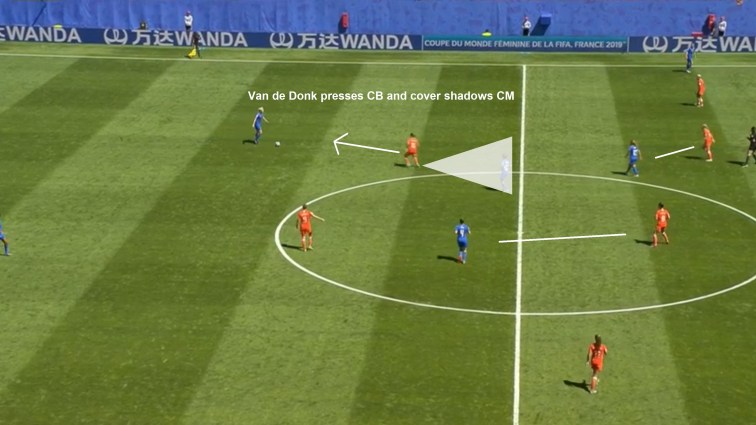
The Netherlands set up defensively in a 4-4-1-1 mid-block, with Van de Donk supporting Miedema in pressing from the front. Miedema isn’t hugely involved in pressing, but Van de Donk (again) was crucial not just in her aggression, but with her angling of runs. Italy technically had an overload of 4v3 in midfield, but they were unable to make use of it. Van de Donk would often press the ball-playing Italian centre-back whilst simultaneously cover shadowing their deepest midfielder, Giugliano. With Groenen and Spitse covering Cernoia and Galli, this made it hard for Italy to find their central midfielders and build through the central channels.
Italy probably weren’t helped by the absence of Girelli, whose dropping movements from the frontline and ability to hold the ball in under pressure have created opportunities to progress the ball for Italy throughout the tournament.
Another issue was Italy’s lack of offensive width, which again came through the shape change. Normally, their full-backs, central midfielders and wingers could combine, but here there were no wingers. The full-backs had to push up more, meaning the distance between them and the centre-backs was greater and stable passing between them wasn’t as possible, while there were less options once they did go wide. Aside from diagonal balls over the top of the the Dutch back line for Giacinti and Bonansea to run onto or head, there was little creation from Italy.
Italy were perhaps affected by tiredness from a lack of rotation in the group stages, but their shape change was the most noticeable problem here. By contrast, the Dutch looked more cohesive than they had done previously – a dangerous sign for their opponents going into the semi-finals.
GERMANY 1-2 SWEDEN
Germany have been one of the most tactically versatile teams at the World Cup, changing their strategy in different phases depending on the opponent. Against Spain they sat back, defended zonally in a 4-4-2 and counter-attacked; against Nigeria they attacked in a fluid 3-3-4 shape that saw Leupolz playing between the centre-backs in build-up.
Here they lined up in a 4-4-2, with the major modification being Popp’s deployment at the base of midfield. An attacking player with a scoring record of just under one goal every two games for her country, her selection alongside the also offensively minded Dabritz in the centre raised eyebrows. Elsewhere, the defence of Gwinn, Doorsun, Hegering and Simon in front of Schult was no surprise, while up front Schuller led the line with support coming from deep from Magull and wide from Huth and Dallmann.
Sweden kept it simple, lining up in their usual 4-4-2. The names were also familiar: Lindahl in goal, Glas, Fischer, Sembrandt and Eriksson in defence, Jakobsson, Rubensson, Seger and Rolfo in midfield, and Asllani behind Blackstenius up front.
SWEDEN SCREEN POPP
Popp playing at the base of midfield was perhaps a ploy by Germany coach Martina Voss-Tecklenburg to get her star player more involved in the team’s possession. Having Popp deeper theoretically meant she could receive from the centre-backs before using her excellent accuracy and range of passing to find forward passes and switches of play that would open up or stretch the Swedish defence. However, in practise, this didn’t quite work out.
Sweden defended in a 4-4-2 mid-block with zonal coverage that saw them focus on retaining their shape at almost all costs. Their front two of Asllani and Blackstenius did a good job of screening Popp, either directly blocking passes to her or threatening them by keeping a close distance to the German playmaker. If one of them went to press the German centre-backs, they made sure to cover shadow Popp behind them, meaning a straightforward pass from Hegering or Doorsun into Popp’s feet wasn’t possible. As a result, Germany rarely got Popp on the ball and couldn’t make use of her aforementioned passing qualities.

The only way Germany could comfortably find either of their midfielders was for one of them to drop deep alongside the centre-backs, taking up a position in front of the Swedish defensive block rather than between lines. Dabritz often did this in the first half, before Magull took on the role in the second half. As Sweden wanted to retain their defensive shape, they didn’t follow these dropping movements, instead allowing Dabritz to receive the ball freely. Dabritz could then drive forward and try to commit defenders. She could also look to create an overload on the left-hand side with left-back Simon, the nearby winger and a dropping forward (in this case Magull).

However, Sweden were resolute in not being drawn out of position individually or collectively being drawn to one particular area or side of the field. Instead they generally allowed Germany to have possession in non-threatening areas, not applying too much pressure to the ball or going player-to-player. In doing so, they kept a compact shape and made it tough for Germany to break the lines.
SWEDEN DIRECTNESS PANICS GERMANY
Sweden didn’t concentrate on building possession from the back against Germany, who defended quite passively in their own 4-4-2 zonal mid-block. Instead, they constantly looked to play over the top of the German defensive line, looking for the runs in behind of striker Blackstenius and Jakobsson, who targeted space intelligently with inward runs from her right wing starting position.
One benefit of this approach was defensive – it stopped Germany from being able to consistently turn the ball over in midfield, as they did in the group stage match with Spain, before counter-attacking from the middle third or higher. But the main benefit was that it exploited the disorganisation in Germany’s back four, particularly between centre-backs Hegering and Doorsun. Too often there were huge gaps between the centre-back pairing, which created space for Swedish attackers to run through.
It seems Sweden coach Peter Gerhardsson also noticed Germany’s defensive issues before this game…
GERMANY LEAVE THE BACK DOOR OPEN
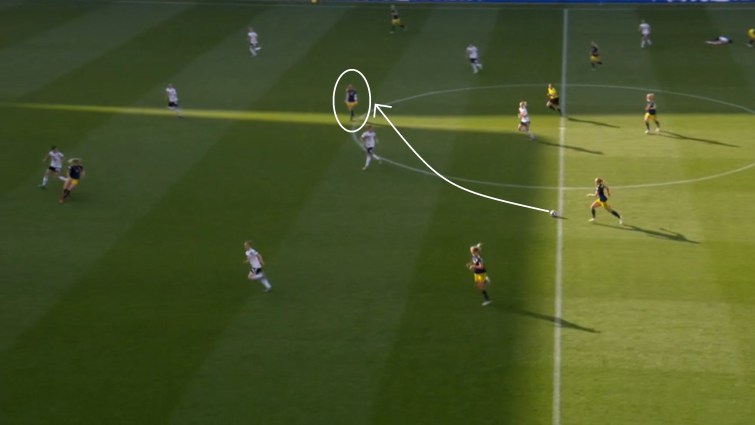
Germany have appeared disorganised in defensive transition throughout the tournament. China constantly got in behind their back line after regaining possession and instantly counter-attacking, and Sweden did the same here. Germany like both of their full-backs to get forward, and with no midfielder dropping between the centre-backs in this game Hegering and Doorsun were even more exposed than usual. This wasn’t helped by the presence of two attacking midfielders in central midfield positions – Popp and Dabritz were not able to stop Sweden penetrating in transition and often didn’t position themselves to protect their central defenders.


When Sweden won the ball they played directly, only this time into more space than when they had organised possession. Not only was Germany’s setup for defensive transitions poor, but their centre-backs at times appeared unsure of what to do about Asllani’s deeper positioning and made some poor decisions in the process. Asllani (circled) often looked to move between the Germany midfield and defence lines, and she found separation in transition to receive through balls and attack Germany’s centre-backs. While mostly Sweden played long balls over the top of the German centre-backs for Blackstenius to run onto, they sometimes played into the feet of Asllani.
GERMANY CHANGES DON’T WORK
The sight of star creator Marozsan coming on for Dallmann at half-time would worry most teams, but Germany rarely found her in the second half. Sweden’s zonal defence remained compact throughout, limiting the space Marozsan could find and the time she had on the ball whenever she did receive it. There were some slight changes made by Germany as the match wore on, but most of them were simply to do with personnel. Magull dropped into Dabritz’s role, while Dabritz moved to the right wing and Marozsan came into a central position behind Schuller. Then Oberdorf came on for Schuller and Popp went into her usual more advanced role. But Germany’s problems were mainly tactical, and not to do with a lack of individual quality.
They were able to pin Sweden back into a deeper defensive block as the game wore on with their full-backs pushing higher. Sweden didn’t want to lose their shape, but they also didn’t want their own full-backs to be overloaded 2v1, so they dropped back collectively and their wingers could better track the German full-backs’ forward movements.
Germany, as always, had good presence in the opposition penalty box when it came to balls over the top from deep or crosses in from wide. There were always three players to hit in the Sweden box from crosses, and this caused some problems as Sweden goalkeeper Lindahl made some rash decisions coming out to punch away.
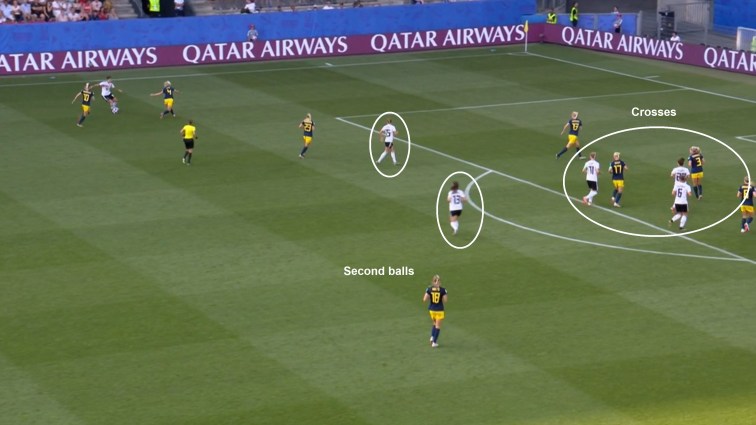
Even if Germany didn’t win the header and get an immediate shot off, they always had good support for loose balls in and around the box from Magull, Dabritz, Dallman and/or Popp. But they struggled to create clear scoring opportunities this way, in part because Sweden’s centre-backs are aerially strong. Germany also missed the deliveries of Simon, who went off through injury in the first half.
While Germany had a lot of possession but no real penetration, Sweden were the opposite: they had 36% of ball possession, but regularly found space between and behind the German back line for their front four to run into, get on the ball and create chances. Their play was simple, but effective, and was enough to seal a semi-final berth.
 WoSo Analysis