Netherlands 4-3-3 (Van Veenendal – Van Lunteren, Decker, Bloodworth, Van Es – Groenen, Spitse, Van de Donk – Van de Sanden, Miedema, Martens)
Cameroon 4-2-3-1 (Ndom – Meffometou, Manie, Johnson, Leuko – Yango, Feudjo – Abam, Mbeleck, Onguene – Enganamouit)
Cameroon altered their shape for their second World Cup game against the Netherlands, switching from the ultra-defensive 5-4-1 they used against Canada to a 4-2-3-1 involving man-oriented defensive coverage.
Their striker, Enganamouit, didn’t engage in a lot of pressing so the Dutch centre-backs often had time on the ball, though their nearest potential passing options were generally covered man-to-man. Mbeleck marked Spitse, while the near-side Cameroon central midfielder would step up to pressure their opposite player when they dropped to receive the ball. The wingers, Abam and Onguene, positioned themselves in the channels between the Dutch centre-backs and full-backs, looking first to cut off or intercept passes between these players.
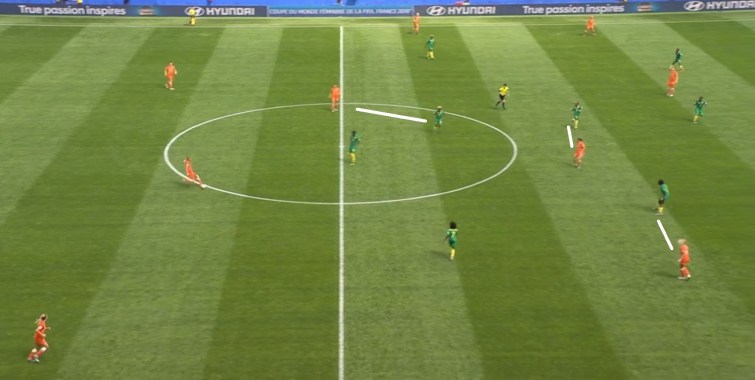
For the second game in a row, Netherlands struggled to effectively build out against an organised defensive team. They were also panicked by Cameroon’s strategy in transition – playing directly over the top of the Netherlands back line at every opportunity, looking for the runs in behind of their forwards. Onguene was a particular threat in transition, with her pace and movement allowing her to break the last line in such situations. She ended up scoring Cameroon’s equalising goal from this type of scenario.
However, in the second half the Netherlands adapted well to the Cameroonian defensive approach. Not only did they pass at a higher tempo, but they manipulated their opponents’ man-orientations through movement.
One pattern that was used regularly was the following: left central midfielder Van de Donk dropped to receive the ball from the centre-backs, in doing so encouraging her direct opponent to move up and press her. This created space behind, which left winger Martens moved into. Van de Donk would play a 1-2 with the centre-back, and the centre-back could then pass forwards to Martens, breaking the lines in the process.

Another route forward for the Netherlands was for their centre-backs to show more bravery, driving forward with the ball to commit defenders and create freedom for the Dutch central midfielders, who could then move on the blind side of their distracted direct opponent to receive a line-breaking pass from the centre-back.
Along with these movements and combinations, the Netherlands attacked quicker and more directly. They hit their wingers with diagonals from the centre-backs, rather than working it from one side to the other via three or four passes that allowed Cameroon to shift comfortably. These passes also got Martens and Van de Sande, two very quick and skilful wingers, into more 1v1 situations.
 WoSo Analysis