Canada 3-1-4-2 (Labbe – Schmidt, Buchanan, Zadorsky – Scott – Riviere, Fleming, Lawrence, Beckie – Sinclair, Prince)
New Zealand 4-4-2 (Nayler – Bott, Stott, Erceg, Riley – Chance, Bowen, Percival, Hassett – Gregorius, White)
New Zealand caused the Netherlands problems in their opening game, and lined up in the same shape here. They defended in a 4-4-2 mid-block with zonal coverage that saw their midfield four and front two shift collectively towards the ball-side, looking to stay compact and take away gaps for Canada to penetrate. While the Netherlands struggled to break through New Zealand’s defensive block, Canada adapted their system to ensure success.
Kenneth Heiner-Moller lined his side up in a basic 4-2-3-1 shape for their win over Cameroon, though here they shaped up in a 3-1-4-2 in possession. Central midfielder Schmidt showed her versatility, playing on the right of the back three here, while Riviere and natural winger Beckie acted as wing-backs. Lawrence joined Fleming as a No.8, while Prince joined Sinclair up front. The new system had many benefits.
While the Netherlands, in their 4-3-3, were reduced to ‘u-shape’ passing among the back four by New Zealand’s compact defensive block, Canada’s back three made it easier for them to play around New Zealand’s two-player first line of defence – they would work the ball to one of the outside centre-backs, who could then drive forward with the ball at feet and had time to decide upon her next action.
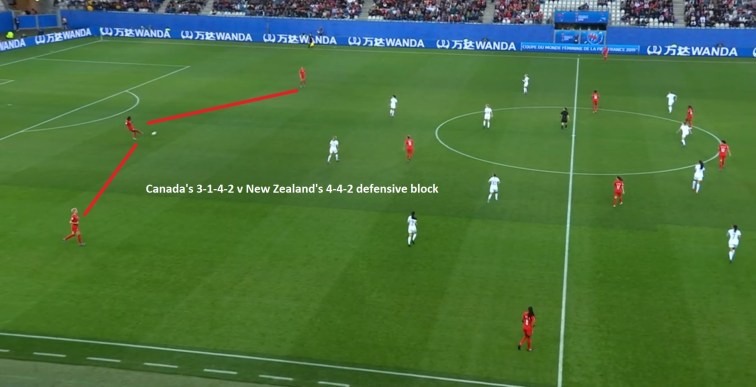
New Zealand struggled to press Schmidt and Zadorsky, Canada’s outside centre-backs. Their front two were outnumbered 2v3, while their wingers couldn’t step up as doing so would have left their full-backs overloaded by Canada’s wing-backs, No.8s and strikers.
Canada often used their wing-backs’ wide positioning to stretch the New Zealand midfield line and open the channels between the wingers and the central midfielders to play through to Lawrence and Fleming, who often took up positions in these channels and between the lines to enable these passing lanes. Canada also used passes from Schmidt to Zadorsky – skipping centre-half Buchanan – to quickly switch the angle of attack and try to open gaps in New Zealand’s midfield line to penetrate.
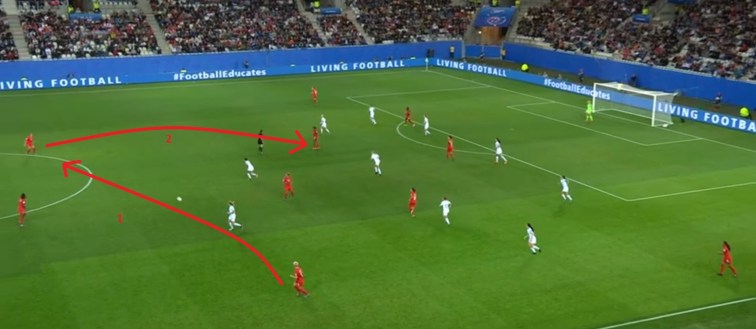
If Canada couldn’t play through the lines, they had other methods of attack to use. One was diagonal switches from outer centre-back to the far-side wing-back (Schmidt to Beckie, for instance) – in doing so, they drew New Zealand’s zonal defensive block to one side before exploiting space on the far flank to get their wide players into 1v1 situations or go around the block.
Another option was simply to bypass midfield and go over the first two lines of New Zealand defence, from centre-back to Sinclair. Sinclair, who is strong, aerially dominant and excellent with her back to goal, would regularly drop off the front line to receive chipped passes over the top. She would then hold the ball in before finding a teammate. Alternately, she would flick the ball on and a teammate would make the run in behind her.
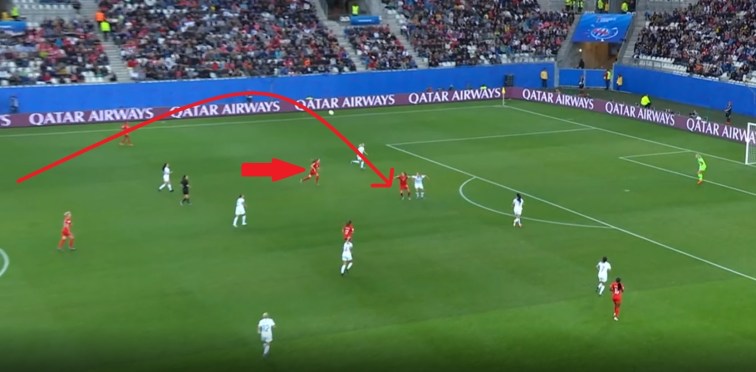
Opposite movements were also used by the strikers and No.8s to try and create openings to break the lines. The New Zealand defenders would have to decide whether to stay back and risk the dropping striker being un-marked and free to receive, or they would have to go with the dropping striker and risk the No.8 running into the space on their back line to receive in behind. While these situations rarely threatened New Zealand, they were another example of Canada’s intelligence in possession.
New Zealand changed from 4-4-2 to 5-3-2 in the second half, with Gregorius going off and being replaced by Green, who went to left centre-back. Hassett moved up front with White. This change helped New Zealand to stymie Canada’s progression by essentially matching them player for player, but they still couldn’t gain control of possession and create any real quality chances. Canada went to 3-4-1-2 towards the end of the game, with Quinn joining the indefatigable Scott in defensive midfield to see out an impressive 2-0 win.
 WoSo Analysis