Japan 4-4-2 (Yamashita – Shimizu, Kumagai, Ichise, Sameshima – Nakajima, Sugita, Miura, Endo – Sugasawa, Iwabuchi)
Scotland 4-2-3-1 (Alexander – Smith, Corsie, Beattie, Lauder – Little, Weir – Evans, Cuthbert, Arnot – Ross)
Japan made personnel changes after their draw with Argentina, bringing in Iwabuchi up front in place of Yokoyama and swapping Hasegawa on the left wing for Endo. They kept the same 4-4-2 shape, however. Scotland made a slight tactical tweak after their defeat to England, introducing Little to a deeper role while Ross played ahead of Cuthbert up front. At left-back, natural attacking midfielder Lauder was brought in, while winger Emslie – who scored against England – was left out for fitness reasons.
Scotland build-up was based around working the ball from the centre-backs to deep-lying Weir. Weir would receive and look to spread play to the far side, playing switches to the wingers. The aim seemed to be using Weir’s passing range to play around or stretch Japan’s compact defensive block, then getting the wingers into 1v1 situations where they could dribble at the opposition full-backs.
This plan didn’t work often, mainly because of Japan’s defending. They defended in a 4-4-2 shape with a high press led by the strikers, Sugasawa and Iwabuchi. They actively looked to press Corsie and Beattie, the Scottish centre-backs, and force them to go wide to the full-backs. Once there, the near-side Japanese winger would press the ball, while the near-side striker would cut off the pass back to the centre-back and the far-side striker shuttled across to cover Scotland’s deepest midfielder.

Japan’s pressing meant Scotland couldn’t always get the ball to Weir, and they struggled to play through the lines even when they wanted to. This was not helped by a high Japanese back four that was constantly looking to squeeze the space between the lines. They did this in the belief that balls over the top could be covered by their centre-backs’ pace to recover. So Scotland’s only viable option was to switch the play and go around the outside.
Dominating possession less than they did in their opener with Argentina, Japan found it easier to play through a less defensive opponent this time around. Their wingers, Nakajima and Endo, would come inside to the inside and central channels, ensuring they had plenty of options to seek out inside Scotland’s 4-4-2 defensive block. While Scotland tried to stay compact, they couldn’t always prevent the penetrative passing lane from opening up. And, when Japan did play through them, their front four combined well through lay-offs and one-twos to continue the attack. At worst, Endo and Nakajima’s inside positioning pinned the Scottish wingers and full-backs, creating more space for Japan’s full-backs to receive near their touchline.
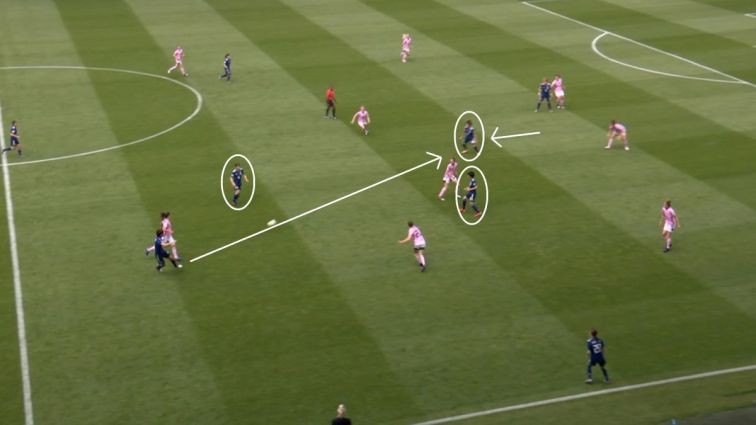
Scotland posed a threat from set pieces through the height of Beattie and Corsie, but they weren’t always able to find their tall players. At free kicks, Japan kept a very high defensive line that moved Scottish aerial targets away from the goal they were attacking and reduced their scoring threat in the process.
With intelligent and aggressive pressing, quick and tidy passing and a good attacking structure, Japan were able to play out effectively while generally stopping Scotland from doing the same.
 WoSo Analysis